Prove your SIEM catches real attacks.
A silent rule looks the same as a quiet week. LogLens shows which attacks your logs can detect, then runs a drill to prove each detection fires.
Why coverage needs proof
How LogLens proves it
Beside your SIEM, on its own virtual machine, with a read-only account.
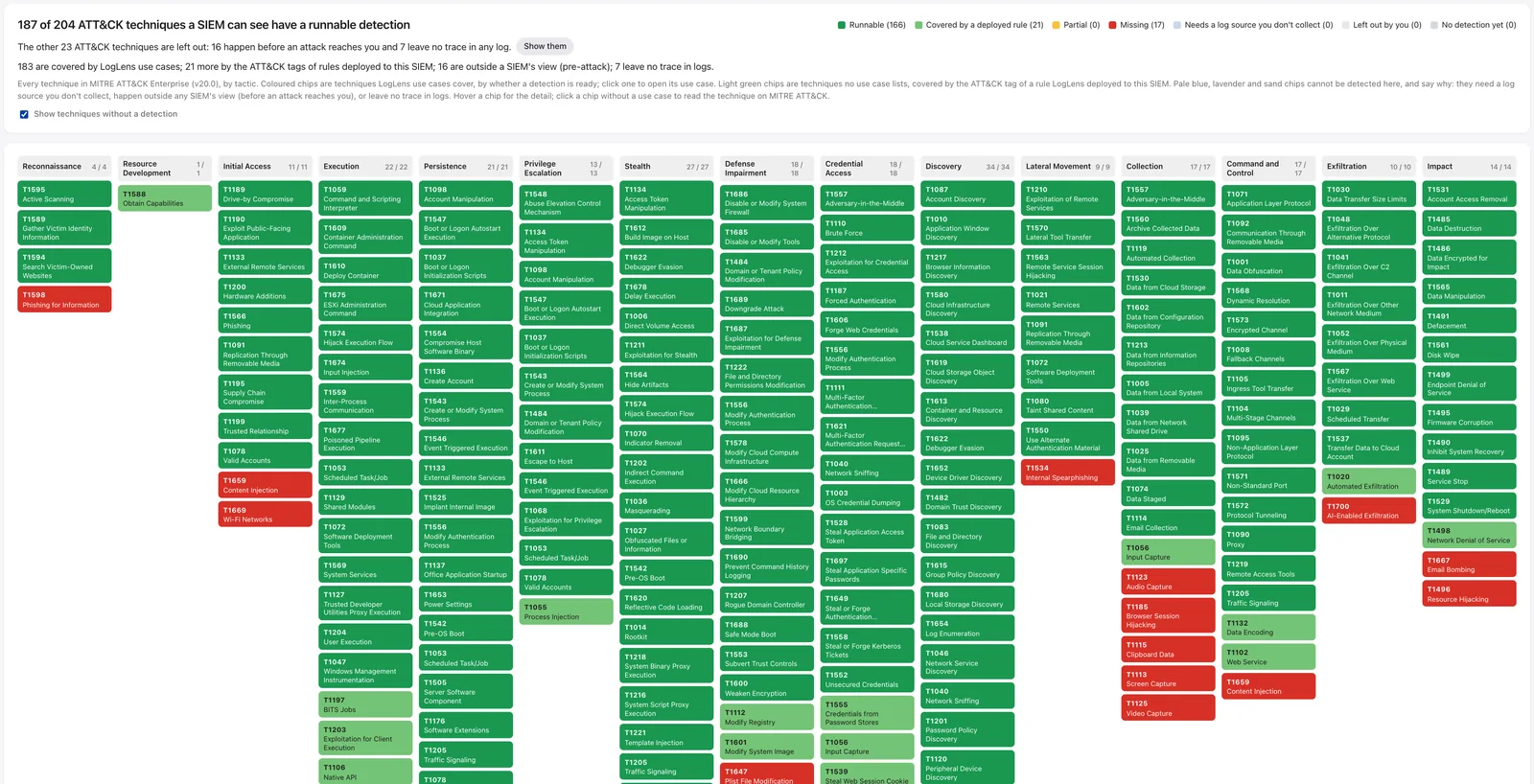
See what you can detect
Every ATT&CK technique a SIEM can see, coloured by whether your logs can run a detection for it today.
Know what to add next
The log sources you’re missing, ranked by how much detection each one unlocks.
Prove each detection fires
Fire Drill sends made-up attack logs the way your real logs arrive. A drill passes only when the deployed rule’s own alert names it.
Keep it true
Alerts when a detection goes quiet, and a list of the use cases that need a retest.
Checked, not just claimed
Read more
How to make your SIEM smarter
Correlation, context and tuning, for fewer and better alerts.
Read it → SIEMHow to prepare your SIEM to detect real-world attacks
Start from the attacks that are actually happening.
Read it → SIEMHow to detect a red team with your SIEM
The signals a penetration test leaves in your logs.
Read it →Questions, answered
Not unless you ask it to. It connects with a read-only account and only searches. Pushing detections into your SIEM is a separate, optional step with its own credential, and nothing is created until an administrator has reviewed exactly what will be added. Fire Drill, the optional detection test, adds made-up test logs through a credential of its own, and only when you run it.
Yes, that is the point: the alert is the proof. Your SIEM treats a drill like any other activity, so it may notify your team; let them know before you run one. Every host, user and address in a drill is made up, nothing is attacked, and drills run only when someone starts them, or before a proof expires if you turn on Keep proofs fresh.
It reads from Splunk, Microsoft Sentinel, Elastic and OpenSearch, Wazuh, Graylog, IBM QRadar, Google SecOps, CrowdStrike Falcon Next-Gen SIEM, Sumo Logic, Exabeam and Devo, as well as exported log files. It can deploy detections to Splunk, Sentinel, Elastic, OpenSearch, Wazuh, Graylog, Google SecOps, Microsoft Defender XDR, CrowdStrike and Sumo Logic.
For your team
See LogLens on your own SIEM
Tell us which SIEM you run and we’ll show you what your logs can detect, and how a Fire Drill proves it.
- We reply by email to find a time that suits you.
- We only use your details to reply to your request.
- Prefer to try it yourself? Start a free trial →