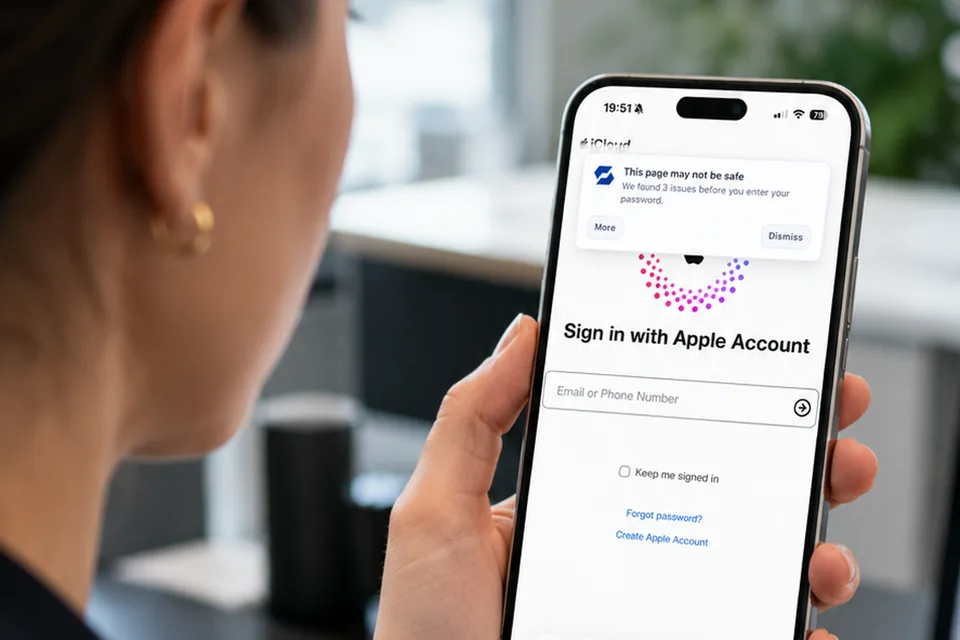
Every client is one click from an incident. You’re one click from containing it.

You’ve seen how one wrong click ends. SafeToOpen protects your customers’ clicks with zero-day detection their Defender-and-DNS stack doesn’t have, deployed per client in under 30 minutes from one multi-tenant console. When something does get through, one confirm blocks the URL in that client’s Umbrella, Zscaler, Defender or firewall, signs the user out and pages your on-call: seconds from verdict to containment, not a ticket waiting for the next shift.

  • New recurring revenue on every managed seat
  • Multi-tenant SaaS — no infrastructure to run
  • Clients deployed in under 30 minutes
  • Incidents contained in seconds through 25+ tools your clients already run
  • Ingest your own threat feeds, blocked in every client workspace

Four products to protect your clients

Add SafeToOpen's full protection layer to your security offering — deploy any or all of it per client, managed from one multi-tenant console.
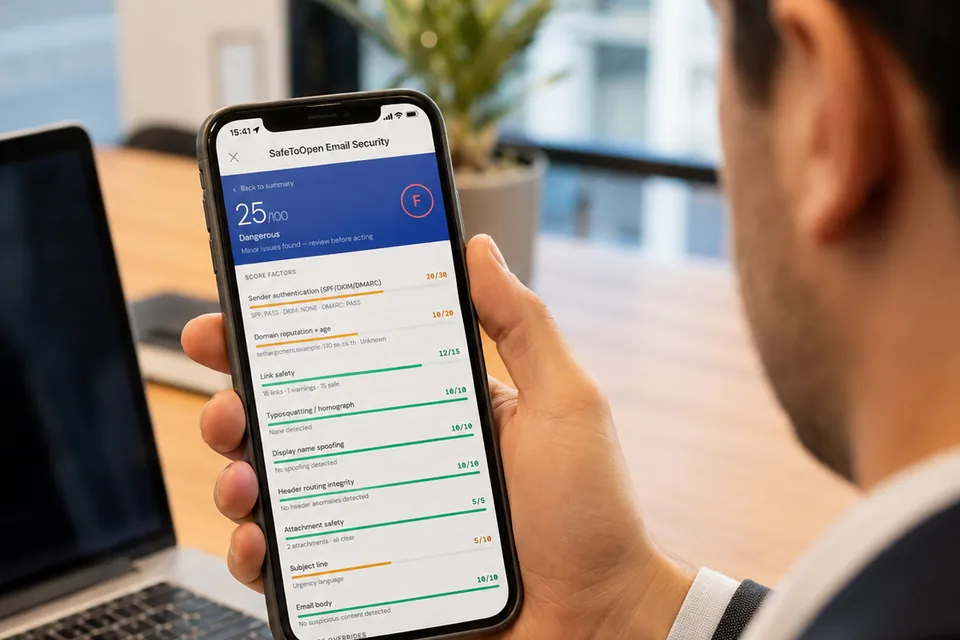
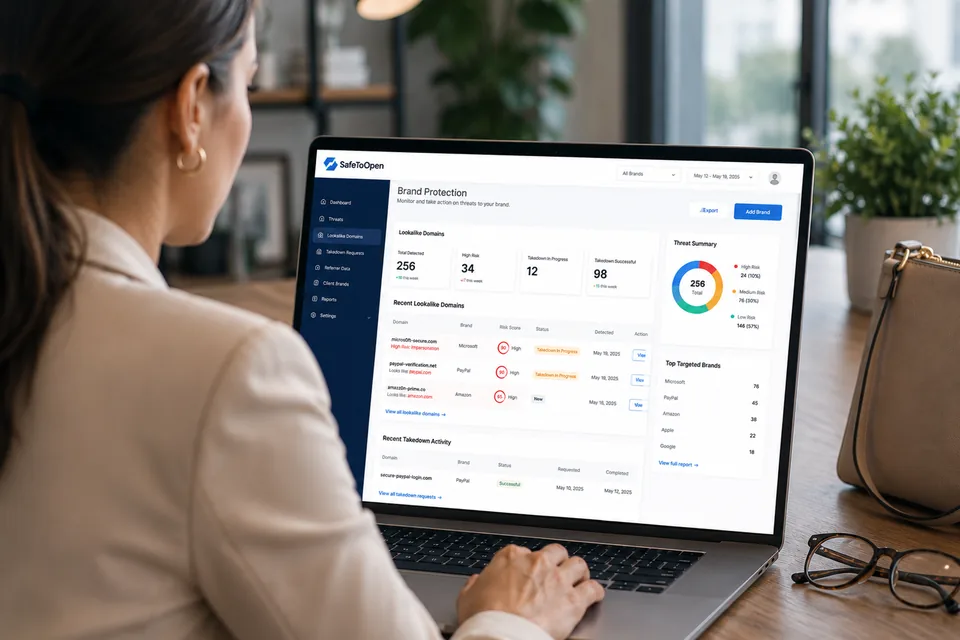
All managed from one multi-tenant console, with threat feeds and reporting. For the SOC-side detail — workspaces per client, least-privilege analyst access, SIEM and ticketing integrations — read the Browser Security capabilities & data-protection overview →. For every connector, feed and MDM tool, see Integrations & automated response →. Become a partner →

Four products protect your clients. The fifth one measures them.

Scam Check is a per-campaign assessment you can run for any client and white-label end to end — your name, your logo and your colours from the invitation through to the result screen. It gives you a per-person score to put in a QBR, a baseline to re-measure against once you have deployed, and evidence for the conversation about what to buy next. Because it is paid once per campaign rather than per seat, it prices like an engagement instead of another line on the monthly bill.

  • White-label throughoutRecipients never see our name.
  • Regional question packsNZ, Australia, the UK, US and Canada.
  • Test clients, not just staffVolume rates for testing a customer base.

Multi-tenant management

Onboard and manage all your clients from a single console, with per-tenant policies and visibility.

Bring your own threat feeds

Point SafeToOpen at URLhaus, OpenPhish, PhishTank, MISP, your TAXII server or any vendor list, and every URL in it is blocked in each client workspace within minutes. Feed entries stay yours and are never shared with SafeToOpen.

Reporting that sells

Show clients the threats you blocked — clear reporting that demonstrates the value you deliver.

Detection the usual stack doesn’t have

Most managed-security tooling only stops threats once they’re already known. SafeToOpen detects zero-day, never-before-seen phishing as it appears — with a cloud-managed console and instant alerts that make enterprise-grade protection scalable across every client.

Caught at first sight

Zero-day phishing sites are identified the moment they appear — before they reach your clients' users, not after someone else reports them.

Data never leaves the browser

Stops staff submitting passwords, payment details or sensitive information to suspicious sites — and alerts your team instantly, with clear context to respond.

One block, every client

Confirmed phishing URLs are blocked across billions of protected devices in under an hour — every client benefits from every detection.

Your brand on every warning

Tailor warnings, security messages and branding per client environment, so protection looks and sounds like the service you deliver.

Reporting for compliance

Track unsafe clicks and submissions per tenant — spot training needs, evidence compliance goals, and show the risk you're removing.

Enterprise-grade, zero headcount

Give every client enterprise-grade phishing defence without the cost of building an in-house security team.

Your SOC, moved ahead of the click

SafeToOpen shifts phishing defence from post-click incident response to pre-click prevention — the difference between investigating a compromise and confirming that one never happened.

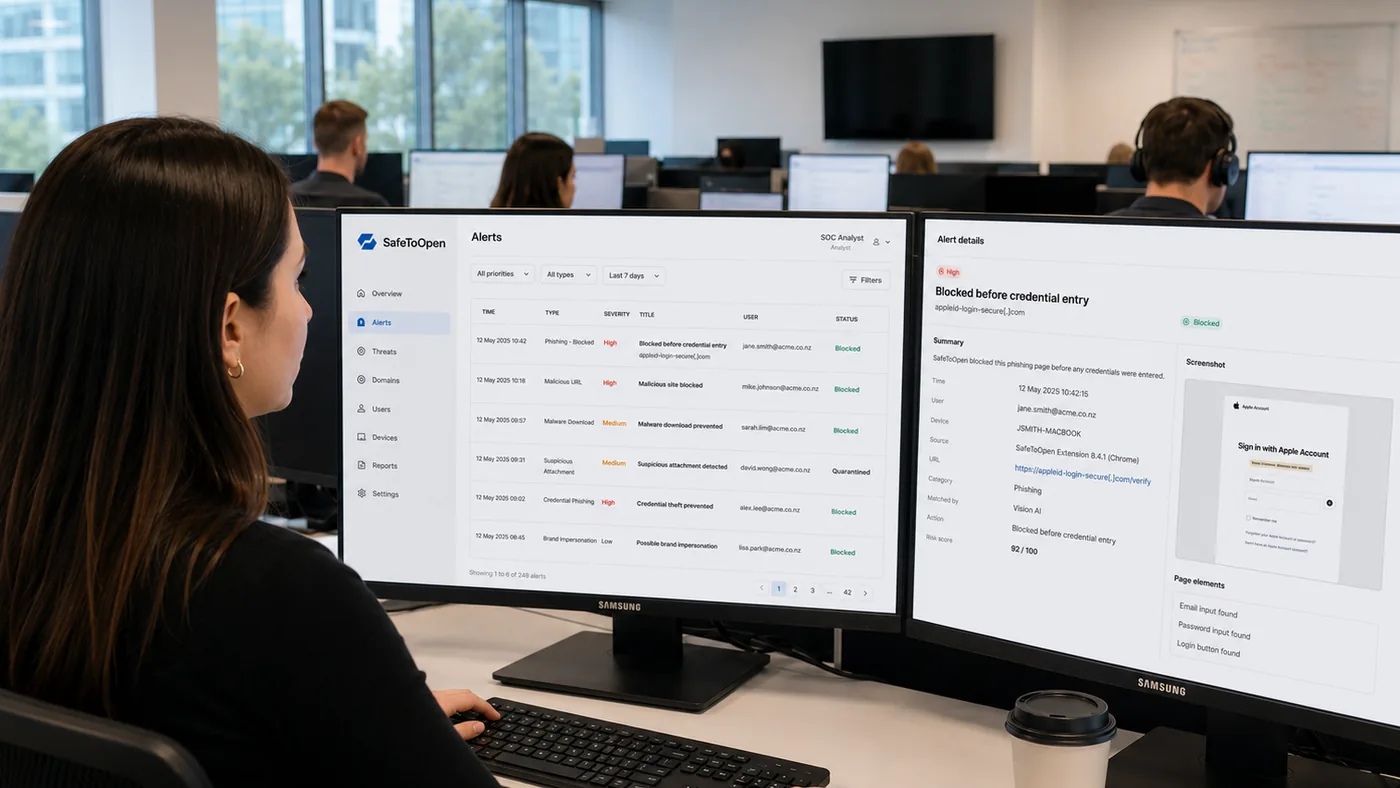
A SOC analyst reviews the SafeToOpen alerts console across two monitors — the alert detail shows a phishing page blocked before credential entry, risk score 92/100.
Reactive — the usual workflow

The incident arrives after the damage

  • A user reports a suspicious email — usually after clicking, often days later.
  • A ticket is raised; an analyst reconstructs what happened from logs and mail-trace.
  • Credentials are presumed compromised: resets, session revocation, mailbox-rule audits.
  • Client communications, incident notes, post-incident review — hours per case, multiplied across every tenant.
Proactive — with SafeToOpen

The alert arrives before the loss

  • The page is judged as it loads, the email as it arrives — including zero-day threats no feed has seen.
  • The user is warned before entering a password; sensitive data is held at the browser.
  • Your team receives an instant alert with full context: tenant, user, URL, verdict, evidence.
  • The “incident” is a notification to acknowledge — not an investigation to run.
Fewer P1 escalationsThe highest-volume incident class — credential phishing — largely leaves the reactive queue.
Context on arrivalEvery alert carries client, user, URL and verdict — triage without log archaeology.
Provable preventionBlocked-before-loss events become QBR evidence of value delivered, not just incidents handled.
Capacity returnedAnalyst hours move from phishing clean-up to onboarding, hardening and higher-value work.

SafeToOpen doesn’t replace your SOC tooling — it removes the most frequent class of incident from it. EDR investigates what ran; SafeToOpen prevents the credential theft that lets it run.

Verdict to containment in seconds, in every client’s stack

Your clients already run a DNS filter, an endpoint agent, a mail gateway and an identity provider. SafeToOpen gives them the verdict those tools cannot produce, then hands it to them: one confirm in the console, in Slack or in Teams, and every configured action runs at once.

Block the URL everywhereUmbrella, Zscaler, Netskope, Cloudflare, Defender for Endpoint, CrowdStrike, SentinelOne, Sophos, Vision One, and a hosted blocklist for Palo Alto, FortiGate, Check Point and Firepower.
Contain the userSign them out everywhere and require a password change in Entra ID, Okta or Google Workspace. Mark the account compromised for conditional access.
Stop the senderBlock the sender for the whole tenant in Microsoft 365, Mimecast, Harmony Email, Cisco ETD, Barracuda or FortiMail, or hand the message to Proofpoint TRAP.
Wake the right personIncident cards in Slack and Teams with one-click Confirm; PagerDuty or Opsgenie pages the on-call above the severity you set.
Scoped per clientConnectors, rules and feeds belong to one client organisation, so no client’s tools ever see another client’s incidents.
Block once, everywhereLink the organisations you manage and a URL confirmed in one client is blocked across all of them in a single action.
Safe to automateRules start in dry-run, fire on confirm or automatically above a minimum severity, and reversible actions can be undone from the console.
One screen for the fleetThe MSP overview shows open incidents, connector health and feed status for every client you manage.

Shadow AI, governed in the browser

Your clients’ staff are already pasting customer data into personal ChatGPT. Name the tools each client sanctions, warn on or block the rest, and put the AI usage report on the table at every QBR.

Sanctioned vs unsanctionedChatGPT, Copilot, Gemini, Claude and forty more recognised out of the box, work and personal editions told apart, three tiers per workspace.
Paste Guard by tierPasted text, the prompt as it is sent and file uploads allowed on sanctioned tools, checked on tolerated ones, refused on unsanctioned ones when they carry personal information.
Tenant restrictions, no proxyMicrosoft and Google Workspace sign-ins limited to your tenants from the extension, so personal accounts cannot sign in on managed browsers.
The AI usage reportWho uses which AI tools, time spent, prompts, uploads, sanctioned share and refusals, per workspace and per person, exported for ISO 42001, the EU AI Act and insurers.

Beyond phishing: the attacks that pass MFA

The attacks that get past your clients’ MFA are the ones your stack cannot see. Browser Security stops them in the browser and gives you the inventory of every app a client’s staff sign in to without SSO.

ClickFix and fake CAPTCHAPages that copy a PowerShell or terminal command to the clipboard and ask the person to paste it into Run. The command is replaced, the person is told, and the SOC gets the payload as a critical incident.
OAuth consent phishingA genuine Microsoft or Google sign-in page granting a malicious app lasting mailbox or files access. The consent screen is read, unapproved apps asking for sensitive permissions are warned on or blocked, and the app and scopes are recorded.
Password AlertThe work password typed anywhere but your identity provider: a proxy phishing kit that mirrors your login, or a personal site. Caught before the submit leaves, with a salted fingerprint that never leaves the device.
Password logins inventoryEvery site where members sign in with a password of their own, per person and per workspace: the apps used without SSO, the accounts nobody knew about, and where the work password was reused.
An MSP owner walks a client through a SafeToOpen Client Security Report on a tablet — threats blocked, users protected, domains checked.

Prevention you can put on the table

Prevented incidents are invisible — which makes security the easiest line item for a client to question. SafeToOpen turns prevention into evidence: client-ready reports showing threats blocked, users protected and domains checked, per client, per period.

Walk into every quarterly review with proof the service worked — not just a list of tickets closed. It’s the difference between defending your invoice and renewing it.

Talk to us about MSP reporting

Built for high-risk client sectors

SafeToOpen protects organizations where phishing, scams and data loss carry the greatest cost.

Financial services

Protects against credential theft, account takeovers and the fraudulent websites that target customers.

Healthcare

Keeps patient information safe and helps organizations meet strict privacy requirements.

E-commerce & retail

Secures online payments and defends against impersonation sites that target customers.

Legal & professional services

Protects sensitive communications and data from phishing and social-engineering attacks.

Education & government

Proactive protection for institutions frequently targeted by phishing and identity-based attacks.

Proof your clients’ reviewers can check

  • ISO/IEC 27001:2022 certified
  • Recognised VirusTotal contributor
  • 4.9 ★ on the Chrome Web Store
  • Independently penetration tested

See the evidence in the Trust Center →

Questions, answered

Yes. The console is multi-tenant — each client is managed separately with its own policies and reporting.

Through the tools you already use. Both products deploy as managed browser extensions via Microsoft Intune, Group Policy or your RMM, with identity from Microsoft Entra ID (Azure AD) or Google Workspace. No MX changes, no mail-flow redirection, no agent on the endpoint.

Both directions. Browser Security ingests the feeds you already licence (URLhaus, ThreatFox, OpenPhish, PhishTank, MISP, any TAXII 2.1 server or STIX bundle, Recorded Future, Proofpoint ET Intelligence, or any plain-text, CSV or JSON list) and blocks every URL in each client workspace on a schedule from 15 minutes to weekly. Entries are never shared with SafeToOpen. Hostile URLs confirmed in a client are also published back as STIX 2.1 or a TAXII collection for your SIEM and MISP.

Yes. Response actions push a confirmed incident into each client’s own stack: Cisco Umbrella, Zscaler, Netskope, Cloudflare Zero Trust, Microsoft Defender for Endpoint, CrowdStrike, SentinelOne, Sophos, Trend Vision One, Microsoft 365, Mimecast, Proofpoint TRAP, Harmony Email, Cisco ETD, Barracuda, FortiMail, Entra ID, Okta, Google Workspace, Slack, Teams, PagerDuty and Opsgenie, plus a hosted blocklist for firewalls. Actions run on one confirm or automatically above a severity you set, and reversible ones can be undone. See Integrations & automated response.

Yes — SafeToOpen supports MSP delivery models. Contact us to discuss SLAs and partnership options.

Unlike generic managed-service tooling, SafeToOpen works directly in the browser and inbox. It detects never-before-seen phishing sites, stops unsafe data submissions, and gives your team immediate alerts with context.

Yes. Warnings, security messages and branding can be tailored for each client environment, so the experience matches the service you deliver.

Yes, per client workspace. Each AI platform edition is sanctioned, tolerated or unsanctioned; tolerated tools show the client's own message, unsanctioned ones warn or block, and Paste Guard refuses pastes, prompts and uploads carrying personal information on them. The AI usage report shows who uses which tools, for how long, and what was refused, and exports to CSV for the client's auditor. See Shadow AI governance.

Yes, per client workspace. The ClickFix guard neutralises pages that trick staff into running a command and sends you the payload; the OAuth consent guard warns on or blocks unapproved apps asking for lasting mailbox or files access; Password Alert catches the client's work password typed into a proxy phishing kit or a personal site; and the Password logins report gives you the list of apps each client's staff use without SSO, ready for the next QBR. See the guards.

Your clients’ auditors will ask about us. Good — we like that question.

ISO/IEC 27001:2022 certified, independently pen-tested, Your clients’ content stays theirs: SafeToOpen never reads or stores form values, passwords, keystrokes or files, and internal domains can be excluded from analysis entirely. Deployment is configurable to your policy. The full due-diligence set — Statement of Applicability, pen-test summary, CAIQ, sub-processors, SLA — lives in our Trust Center, and you’re welcome to hand it straight to your clients’ reviewers. Visit the Trust Center →

Protect managed service providers with SafeToOpen

Start free, or book a walkthrough tailored to your environment.